
»Peace Is More Than the Absence of War« [1]
A conversation with Michael Schmidt-Salomon about the situation in Iran and the relationship between humanism and pacifism
hinz_dsc01249.jpg [2]
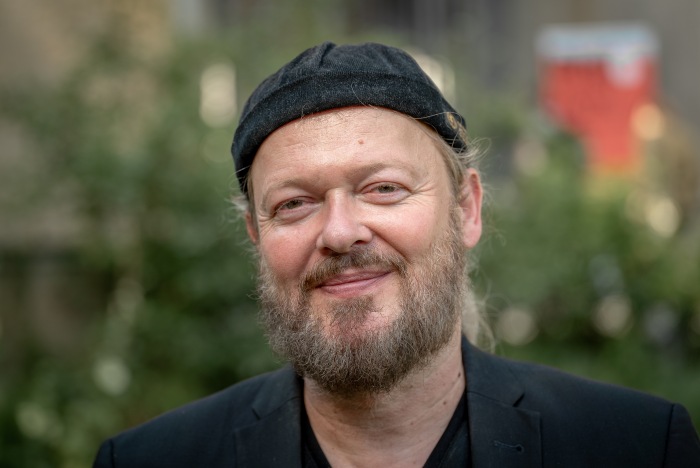
Der Philosoph und gbs-Mitbegründer Michael Schmidt-Salomon (Foto: Ricarda Hinz)
How should humanists respond to the Israeli and American attacks on Iran? What is the relationship between humanism and pacifism? The "Humanistischer Pressedienst" (hpd) spoke about this with the philosopher and chairman of the Giordano Bruno Foundation (gbs), Michael Schmidt-Salomon.
***
hpd: Over the past 20 years, the Giordano Bruno Foundation has sharply criticized the mullah regime and repeatedly sided with the Iranian resistance movement. How do you assess the recent attacks by Israel and the United States on Iran?
Michael Schmidt-Salomon: Ambivalent. The risks and opportunities are roughly balanced. Therefore, in my view, one can neither clearly speak in favor of nor against this war. Simple black-and-white thinking does not do justice to the complicated state of the world.
What do you mean by that?
In this case, we must weigh different aspects against each other: Are the attacks in violation of international law? Very probably. Will this further weaken international law? Presumably. Are innocent people dying in this war? Yes, tragically, this cannot be prevented with such massive bombardments. Are the attacks associated with great dangers for the future of Iran, the Middle East, and for world peace? Undoubtedly, a devastating conflagration cannot be ruled out.
All of these are good reasons to condemn the current war. On the other hand, however, the attacks may create the conditions for the Iranian people to finally free themselves, after 47 bitter years, from an inhumane theocratic dictatorship responsible for the deaths of hundreds of thousands of people. Moreover, the end of the mullah regime would be a massive blow to Islamist terrorism, which has largely been organized from Iran and has brought terrible suffering to Muslims and non-Muslims alike.
Mina Ahadi, the chairwoman of the (gbs-supported) "Zentralrat der Ex-Muslime [3]" (Central Council of Ex-Muslims), explicitly welcomed the targeted killing of the Iranian head of state Ali Khamenei in a Facebook post on Sunday. She said that the history of Iran now has two parts: before Khamenei’s death and after his death…
Yes, and from Mina’s perspective that is entirely understandable! She has been fighting the mullah regime since 1979, her husband and many acquaintances were executed by the regime, and she herself was sentenced to death in absentia. Her moving life story is excellently documented in the film "Mina – Der Preis der Freiheit" (Mina – The Price of Freedom). In addition, the bruno. annual magazine 2023 [4] contains a detailed interview with her about the courageous Iranian resistance movements of recent years. After these movements were brutally suppressed in 2009, 2022, and at the beginning of 2026, Mina now hopes that the regime will finally collapse. And she is truly not alone in this hope: in Germany, many exiled Iranians celebrated the beginning of the war, and even in Iran people danced in the streets when the bombardment began.
Do you share Mina’s optimistic assessment that a democratic transformation can occur and that there will be a "future for Iran without personal dictatorship, without political prisoners, without torture, and without executions"?
I very much hope that this will happen and that Mina will finally be able to travel back to her homeland after such a long time. However, the religious guardians are still – even after the killing of Khamenei and several of their leaders – a very powerful organization. It cannot be assumed that they will voluntarily give up their power. For this reason, I consider the current demands of German and European politicians to immediately end the attacks and return to the "negotiating table" to be dangerously naive. For if one has already begun with "decapitation strikes", that is, the targeted killing of leading protagonists of the dictatorship, one must also carry this through to the end – otherwise the repression against the Iranian people may turn out even worse than before the war began.
That sounds very unusual coming from a humanist philosopher! Can the killing of a human being be justified at all from a humanist perspective?
That depends on the circumstances. As a philosopher who thinks in consequentialist terms, I have always defended "tyrannicide". Of course, killing a human being or even a group of human beings may only ever be the very last resort. It can only be legitimized if there are demonstrably no other possibilities to save lives and defend the values of humanity. This was the case, for example, with the Stauffenberg assassination attempt on Hitler, which from a consequentialist perspective was of course ethically justified. The same applies, in my view, to the killing of Khamenei and other leading figures of the Islamo-fascist mullah regime. Only if they are removed do the people in Iran have a somewhat realistic chance of a peaceful, democratic future.
But is the fundamental humanist formula not "Frieden schaffen ohne Waffen" ("creating peace without weapons")?
Certainly – and in principle this is also a very reasonable maxim! Because wars are always associated with great misery and the loss of many human lives. Moreover, they often do not lead to the desired results but prove counterproductive – as the Iraq War of 2003 showed, which significantly contributed to the rise of the "Islamic State" (IS). But: reasonable maxims apply to the general case, not to the individual case. Sometimes there are good reasons to cross rules. And sometimes weapons are indeed necessary to create peace. Because: "Peace is more than the absence of war" – as Willy Brandt formulated it in 1971 in his remarkable speech upon receiving the Nobel Peace Prize. [5]
True peace requires freedom and justice. Therefore, the people of Iran have by no means lived under peaceful conditions over the past 47 years, but rather in a permanent war. To free them from their hopeless situation, which under the given circumstances can only be achieved by force of arms, can indeed be justified from a humanist perspective.
Do you really want to claim that those responsible in the United States and in Israel are actually concerned with helping the oppressed population in Iran?
Trump and Netanyahu have not exactly stood out as great humanists so far, quite the opposite! Of course, they are not primarily pursuing humanist goals in this war. But that is not the point! Sometimes politicians can do the right thing for the wrong reasons. What seems important to me in this context is this: humanists should finally acknowledge that the use of armed force does not per se, that is, always and everywhere, violate humanist or pacifist values. American pacifists, for example, made this mistake in the 1940s when they vehemently protested against the United States supporting the Allies in the fight against Nazi Germany. It is unthinkable what would have happened if they had prevailed with this view!
But does this critical stance not contradict the position of Bertha von Suttner, after whom the humanist scholarship foundation [6] in which the Giordano Bruno Foundation is also involved is named?
Interestingly, Willy Brandt also referred to Bertha von Suttner and her book "Lay Down Your Arms" in his Nobel Prize speech. In doing so, he spoke of the "naive humanism" of his "very young years". Whether one can attribute such a "naive humanism" to Bertha von Suttner herself I doubt. For she was among the few humanist authors of the 19th and early 20th centuries who engaged intensively with the theory of evolution. Bertha von Suttner therefore knew very well that neither nature nor culture conform to our wishes and moral convictions. Human beings do not become "noble, helpful and good" simply because we hope they will.
With good reason Bertha von Suttner criticized the nationalism and the overflowing enthusiasm for war of her time, but she certainly would not have been naive enough to criticize the entry of the United States into the war against Nazi Germany. For that reason, invoking Bertha von Suttner to oppose German arms deliveries to Ukraine is hardly convincing, since Ukraine depends on such support in its defensive struggle against Putin’s Russia. It is important to distinguish between pacifism and failure to provide assistance.
Speaking of which: it is noticeable that the Giordano Bruno Foundation has published very little about the war in Ukraine, but also about the war in Gaza. Why is that?
There are differing assessments of these issues within the foundation. Therefore I often cannot speak in the name of the foundation, and this also applies to this interview, but only in my own name. As far as Ukraine is concerned: I personally always considered the supposed alternative "deliver weapons OR negotiate?" to be absurd and voted for "deliver weapons AND negotiate!" because one cannot deal with potentates like Putin through good arguments alone. And I already spoke about the political madness in Israel and Iran fifteen years ago in the book "Keine Macht den Doofen" without any consideration. Other Foundation members, e.g. Hamed Abdel-Samad, have done the same.
However, it would be wrong to claim that we as a foundation have not positioned ourselves at all on such questions. For example, we warned very early on about the dangerous religious-nationalist developments in Russia, which became evident at the latest in 2006 with the "Russian Declaration of Human Rights". With regard to the deadly conflict between Jews and Palestinians, we have sharply criticized both the eliminatory hatred of Jews propagated by Hamas and the genocidal intentions of some members of the Israeli government.
Presumably, some gbs sympathisers would have wished for a much clearer positioning of the Foundation on such questions, no?
Yes, that is possible, but precisely in this wish lies a problem – which brings me back to the beginning of our conversation: often it is not appropriate to clearly take sides in a conflict, because a simplistic black-and-white way of thinking does not do justice to the complex global situation. Willy Brandt also pointed this out in his Nobel Prize speech in 1971 – and his words sound today, 55 years later, like a critically rationalist guide to a new, productive culture of debate: "Young people often expect from me the unbroken yes, the clear no. But it has become impossible for me to believe in a single, in ‘the’ truth. (…) Therefore I believe in diversity and thus in doubt. It is productive. It questions what exists. It can be strong enough to break open petrified injustice. Doubt has proven itself in resistance. It is tough enough to outlast defeats and to sober up the victors."
Thank you very much for the conversation!