
»I Am Muslim«
Acceptance Campaign for Diversity and Self-Determination in Islam Launched
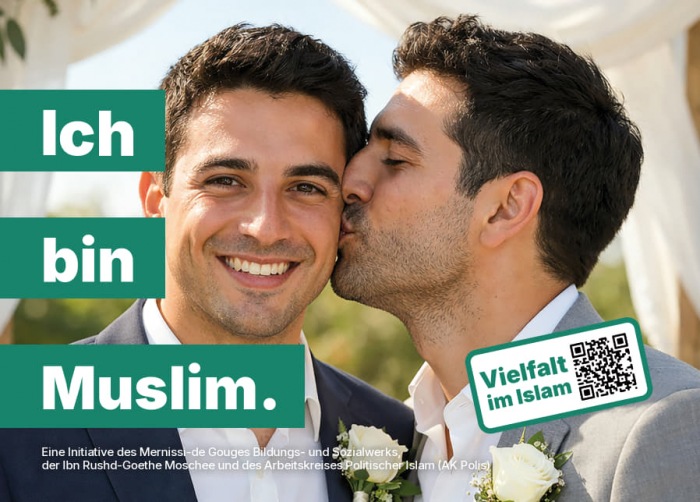
akzeptanzkampagne_muslim_1.jpg
For equal rights and visibility of queer Muslims in a free society (Image: MDG / IRGM / AK Polis. Free for editorial use)
Today, the acceptance campaign "Ich bin Muslim / Ich bin Muslimin" (I am Muslim [m.] / I am Muslim [f.]) was launched in Berlin. Season 1 features four motifs: a Muslim teacher without a headscarf, an intercultural family, a gay couple, and a convivial scene involving alcohol. The campaign thus sends a signal for self-determination and intra-Islamic pluralism, while also shedding light on the hegemonic concepts of "Islamfeindlichkeit" (hostility towards Islam) and "Islamophobiie" (Islamophobia).
The initiative, which is carried by the Mernissi-de Gouges Bildungs- und Sozialwerk, the Ibn Rushd-Goethe Mosque, and the "Arbeitskreis Politischer Islam" (Working Group on Political Islam, AK Polis), which is supoported by the Giordano Bruno Foundation, can now be seen on large billboards throughout Berlin. It is also being displayed on postcards in over 300 gastronomic and cultural venues, cinemas, and on social media.
With this initiative, the organizers are contributing to the "Aktionstag gegen Islamfeindlichkeit" (Action Day Against Hostility Toward Islam) planned in Berlin on 15 March 2026 – while complementing it with a holistic, freedom-oriented interpretation. Under the motto "Islamische Vielfalt leben – Freiheit schützen" (Living Islamic diversity – protecting freedom), they make pluralism within Islam visible. With their commitment to individual freedom of belief and self-determination, they clearly reject Islamist claims to power and cooperation with anti-constitutional actors – and they are being supported in this by Berlin’s Governing Mayor Kai Wegner with a video message.
The project director of the acceptance campaign is Tugay Saraç of the "Anlaufstelle für Islam & Diversity (AID)" (Contact Point for Islam & Diversity). Saraç explains the four motifs featured in Season 1 of the acceptance campaign: a Muslim teacher without a headscarf, an intercultural family of Western character with a Muslim mother, a gay couple, and a convivial scene with rakı. On the selection of the motifs, Tugay Saraç says: "We show Muslim people as they actually live. Muslims are not a homogeneous group. Diversity in Islam is normal – the acceptance campaign makes this visible."
Conviviality beyond Islamist norms – including alcohol
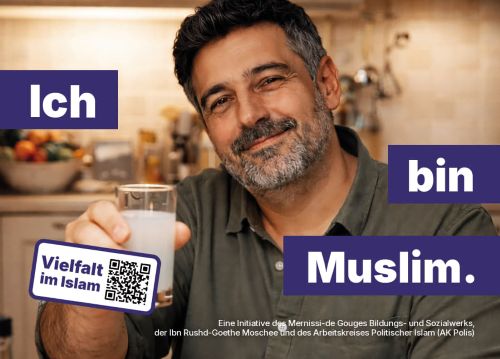
On the motif of the Muslim with alcohol, Saraç says: "Rakı stands here for sociability, for conversation, for the joy of life. Muslim identity cannot be reduced to a rigid prohibition of alcohol, as demanded by Islamist groups. The enjoyment of alcohol has a long tradition in many Muslim-majority societies."
Muslim woman for free partner choice
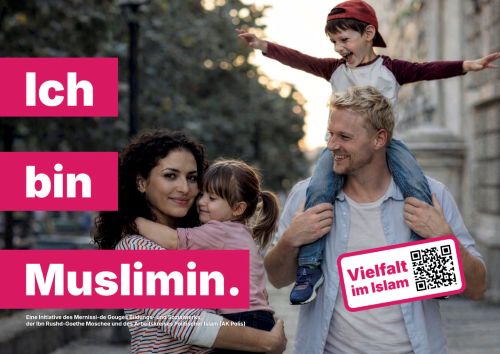
Saraç considers the motif of the intercultural family especially important: "For many people, this is a completely normal family. And that is precisely the point. Yet we repeatedly see that intercultural marriages – especially when a Muslim woman chooses a non-Muslim partner – are strongly rejected by authoritarian and radical currents within Islam. Unfortunately, these attitudes have also gained a foothold in Germany. In not a few cases, this understanding of 'honour' leads to forced marriages and violence. With this motif, we are sending a signal for women's self-determination. She herself may decide about her life and her spouse – not her father, not her uncle, and not her brothers."
Gay Muslim couple for equal rights
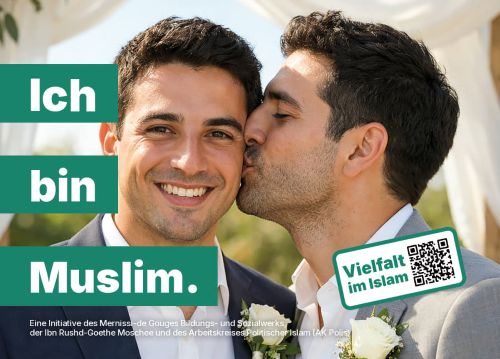
Regarding the motif of a gay couple, Saraç explains: "Queer Muslims are part of our society. This is an achievement of our society in Germany. However, ayone who wants to live openly as homosexual increasingly faces massive rejection in certain Berlin Muslim communities – up to and including bullying and threats. The case of the teacher Oziel Inácio-Stech at the Carl-Bolle-Grundschule in Berlin showed what pressure was built up when Muslim pupils and parents did not accept his homosexuality. To deny him and other queer individuals equal dignity and equal rights contradicts both human rights and the understanding of Allah as a merciful creator. To bully, attack, or even kill a person because of their sexual orientation is misanthropic – and in my view entirely incompatible with Islam."
Muslim teacher for state neutrality
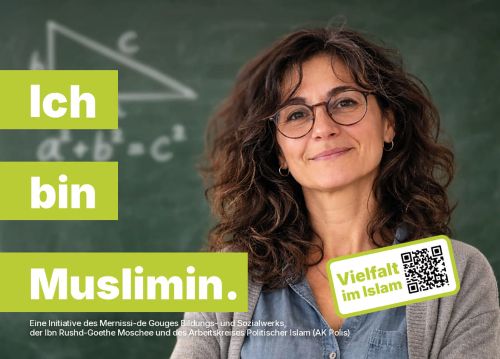
The direction of the acceptance campaign becomes particularly clear on the issue of the headscarf: "Approximately one third of Muslim women in Germany wear a headscarf. Yet Muslim women in advertising and campaigns are almost exclusively depicted wearing one. Islamist groups have been attempting for years to enforce increasingly strict veiling norms in Germany – from the headscarf to the face veil to full-body covering with a burqa or niqab." Saraç says: "It is a marker of collectivism. Our campaign shows that Muslim life in Germany is far more diverse and free. Why should 30 percent represent the supposed norm, while 70 percent remain invisible?"
Against the backdrop of the attacks on the Neutrality Law in Berlin, the decision was made deliberately to feature the motif of a female teacher without a headscarf. Saraç: "We show a Muslim teacher who assumes responsibility in the state education system – without a headscarf. Whether she wears one in private is not shown in the picture, and that is not decisive. What is decisive is that she appears religiously and ideologically neutral in the public sphere."
Saraç concludes: "Our motifs stand for individuals with different biographies and liberal life concepts. They clearly differ from collectivist identity models as represented by Islamist actors. We show the real diversity in Germany. Muslim women and men are not a homogeneous group. Diversity is normal."
Read the full press release on the AK Polis website...